Pulsavi
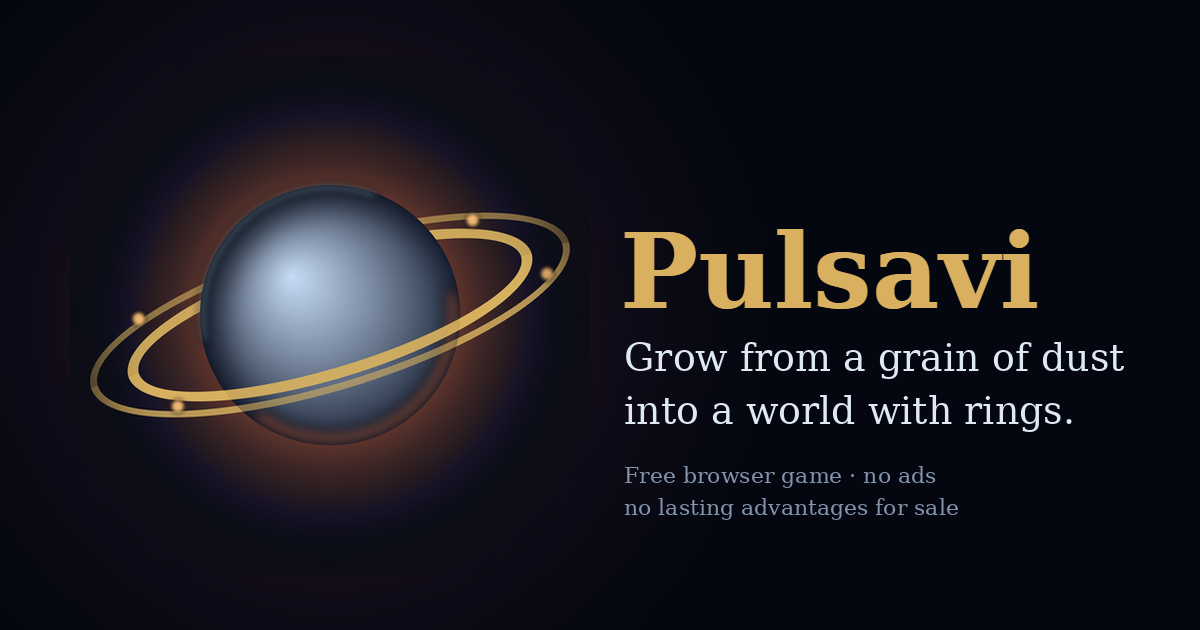
A free browser io game where you start as a grain of dust and grow into a world with rings and moons.
What the game is
Pulsavi belongs to the io genre: a single open field, everything on it is either food or a threat, and the only thing that separates the two is size. You begin at 24 mass, roughly a speck. Stardust scattered across the field feeds you slowly; swallowing a rival feeds you instantly.
What makes it different from the games it descends from is that your body changes visibly as you grow. At 60 mass craters appear. At 240 the core starts to melt and heat shows through cracks. At 800 an atmosphere holds. At 2000 you carry rings and three moons. You can read another player's progress across the screen without a single number.
How to play
Moving
Mouse on a computer. On a phone, drag anywhere — the stick is relative, so your thumb never covers your own body. The game runs in landscape and shows exactly the same amount of field on a phone as on a desktop, so neither device has an advantage.
Splitting
Space, or the on-screen button. Splitting is the heart of the game: a small body always outruns a large one in a straight line, so splitting is the only way to catch anything. It is also how you die, because each piece is half your mass and stays separate for eight to twenty-four seconds before merging back.
Shedding mass
W, or the second button. The lump you throw grows with your own size. Feed enough of it into a pulsar and the pulsar spits out a new one along your line of fire — that is how a hazard becomes a weapon against someone larger than you.
Pulsars
Spiked bodies scattered across the field. Below 240 mass you pass through them and can hide behind them. Above it, covering one tears you into as many as thirteen pieces and leaves you easy prey for anyone smaller.
The four modes
| Mode | Field | How it ends |
|---|---|---|
| Open space | 16818 × 11892 units, 190 bodies to a room | When you die |
| Battle royale | 6000 units, 24 rivals, everyone equal | Last body standing, about five minutes |
| Clan battle | Mirrored arena, two clans | Highest clan mass after five minutes |
| Friendly match | Mirrored arena, equal start | Practice only, no rewards |
Open space is the mode the others practise for: everyone in a room shares one field, and the server decides what happened, not your browser. A room holds 190 bodies. When there are fewer people than that, computer-controlled rivals fill the rest. They are not marked in the arena, but they never count as players: the player number on the start screen counts only people, the lasting leaderboards list only people, and honour comes only from swallowing other accounts. For every person who joins, one computer-controlled rival leaves. Without a connection the same round runs on your own device instead, so the game still works on a plane. The three arena modes are local anyway and need no account.
Clan battles and friendly matches use mirrored arenas on purpose: pulsars sit in point-symmetric pairs and both sides start on equivalent ground. An arranged match on the open map would be unfair, because starting position and stardust are random there.
Progression and designs
There are 100 levels and 46 designs. Twenty-one unlock by level, twenty-five with Ore, the currency you win by playing. Ore comes from your peak mass, from the bodies you swallow, from the stages you reach, and from beating your own best run.
Designs carry a tier from I to V, and the tier is visible on the body: higher tiers are speckled, then banded, then split by glowing cracks, then spiked, and at tier V they pulse and carry a belt of shards. Four tier VI designs cost hundreds of hours and do things nothing else does: a dust trail, a counter-rotating halo, light bending at the rim, cracks cycling through the spectrum. Size tells you who is currently full; tier tells you who has put in the hours. Who is actually good is a separate question, and the game answers it with honour.
Accounts, honour and ranks
An account is free and takes an e-mail address and a password. Without one you can still play every mode, online included, as a guest. With one, your level, Ore and designs live on the server instead of in the browser, so they survive a cleared cache and follow you to another device. Coming back on consecutive days pays a bonus, and there are leaderboards for your country, the world, and the friends whose names you enter.
Honour is the one number in the game that cannot be bought or sat out. It is earned in online rounds by swallowing another account, never a computer-controlled rival, and the same opponent counts once a day. What a kill is worth depends on how close the prey was to your own size — anything under about a third of it pays nothing, so grazing on splinters gets you nowhere — and on how heavy it was. Achievements and the daily bonus pay honour too.
Honour carries twenty ranks, from Cadet to Grand Admiral, shown as a badge beside your name on the field. The lower fifteen are fixed thresholds: once reached, they are yours for good. The top five are places in your own country's standings — the best ten per cent, three per cent, one per cent, the best five, and first — and those can be lost again to someone better. There are also thirty-one achievements, each paid once in honour, for growth, hunting, endurance, coming back, collecting and levels.
What this game refuses to do
No advertisement can interrupt a round — the minimum gap between breaks is enforced in the code, not promised in a policy. Every design can be earned by playing, and in the Liga everyone starts equal — no level bonus, no moons. There are no random loot boxes.
These are deliberate answers to the complaints players make about the games this one descends from: an advertisement after nearly every death, unmoderated names, and dying within a second of spawning. Pulsavi fills quiet rooms with computer-controlled rivals — an empty field is no fun. It also filters names to characters anyone can type, protects you for five seconds after spawning, and chooses your starting position as the safest of forty-eight candidates.
Questions
Is Pulsavi free?
Yes. Every design can be earned by playing, and you can play every mode without an account; a free account keeps your progress on the server and adds honour, ranks, achievements and clans.
Does it work on a phone?
Yes, in landscape, with on-screen buttons for splitting and shedding. It can be installed to the home screen and then runs full screen, offline included.
Is it multiplayer?
Yes, in Open space. Everyone in a room shares one field and the server decides what happened, not anybody's browser. A room holds 190 bodies, and while fewer people are online the rest are computer-controlled rivals that split to hunt you, flee toward open space, use pulsars as cover and shoot them at giants. They are not marked in the arena; the player number and the lasting leaderboards count only people. Without a connection the same round runs on your own device, and the three arena modes are local anyway.
Who made it?
An independent developer. No libraries, no frameworks — the game runs on its own code, down to the typeface. The game has no music; the sounds it makes are the ones that tell you something, and you can turn those off.